VMT HyproScreen

Automated Agar Plate Analysis in Environmental Monitoring
Home
/
Technologies
/
VMT HyproScreen
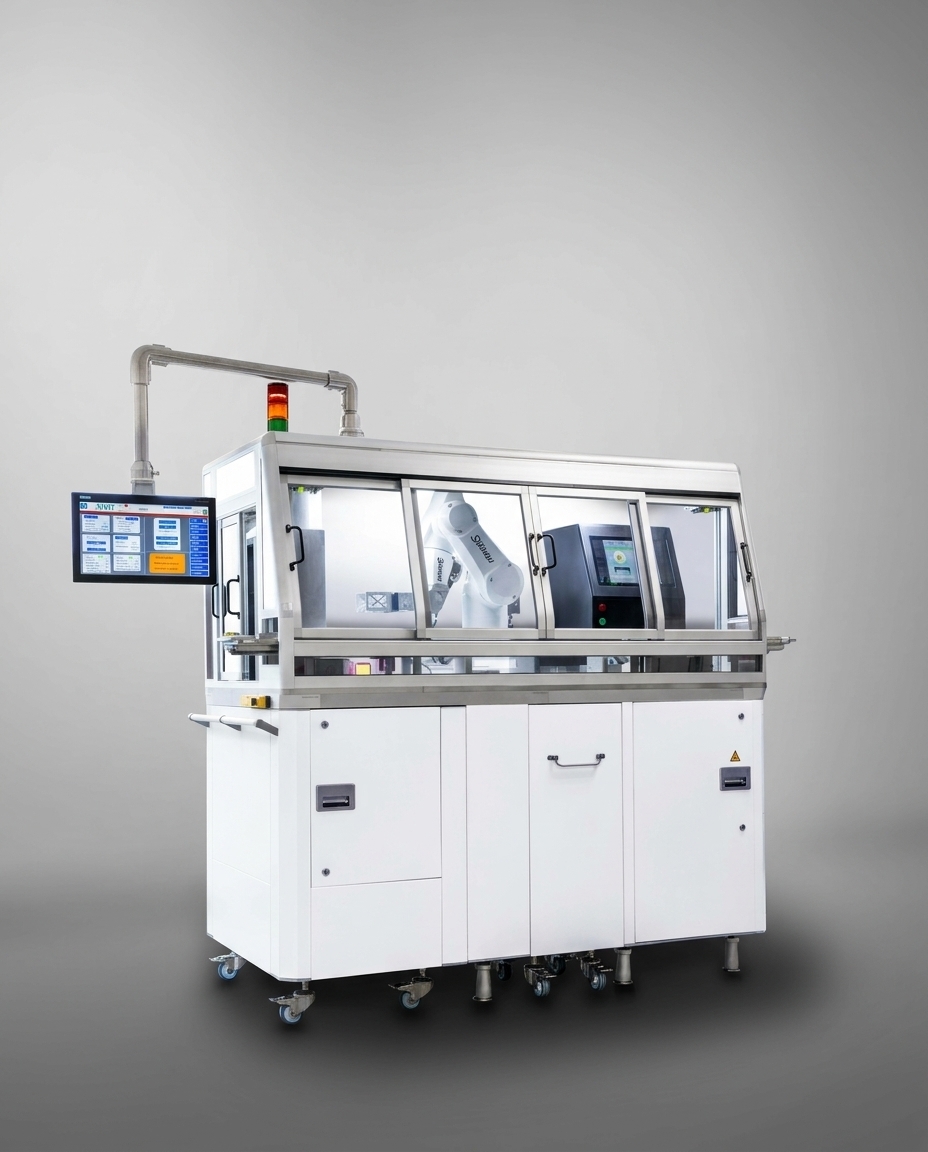
VMT HyproScreen is an image processing system designed for the automated analysis of agar plates used in microbiological environmental monitoring. The system evaluates each plate for findings—such as microbial growth, damage to the agar layer, foreign objects, particles, or bubbles—and assigns it to one of two categories: "OK" plates (showing no findings) require no further inspection, while "not OK" plates are presented to an operator for assessment. Every result is documented automatically and in a tamper-proof manner. The manual inspection station represents the standard configuration: a compact tabletop unit into which the operator inserts the plate. Building on this foundation, the system is available in semi-automated versions featuring a collaborative robot, automatic lid removal, and physical sorting of OK/not OK plates, as well as a fully automated version designed as a closed, high-throughput system. All three configuration levels utilize the same image processing module and analysis logic; the level chosen determines only the degree of automation, not the inspection result itself. Each version is available in configurations suitable for either CNC laboratory areas or Cleanroom Class D (ISO 8) environments.

Modular

An image processing module, three configuration levels – from manual inspection station to fully automated system.

AI-based

Deep learning analysis of the entire plate surface, including the edge area.

GxP-compliant

Audit trail, role concept, and seamless electronic recording
How it works

Panel feeding and identification
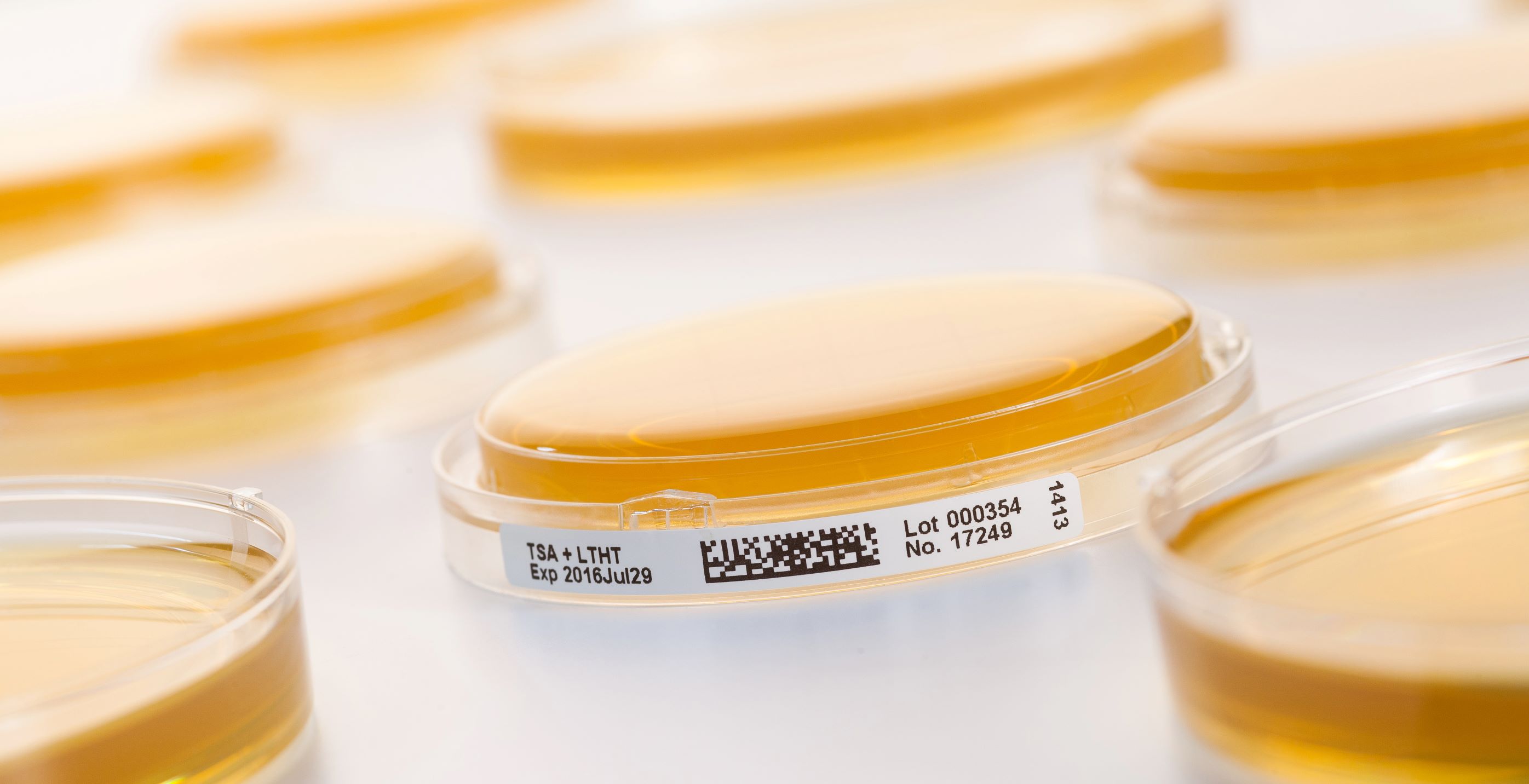
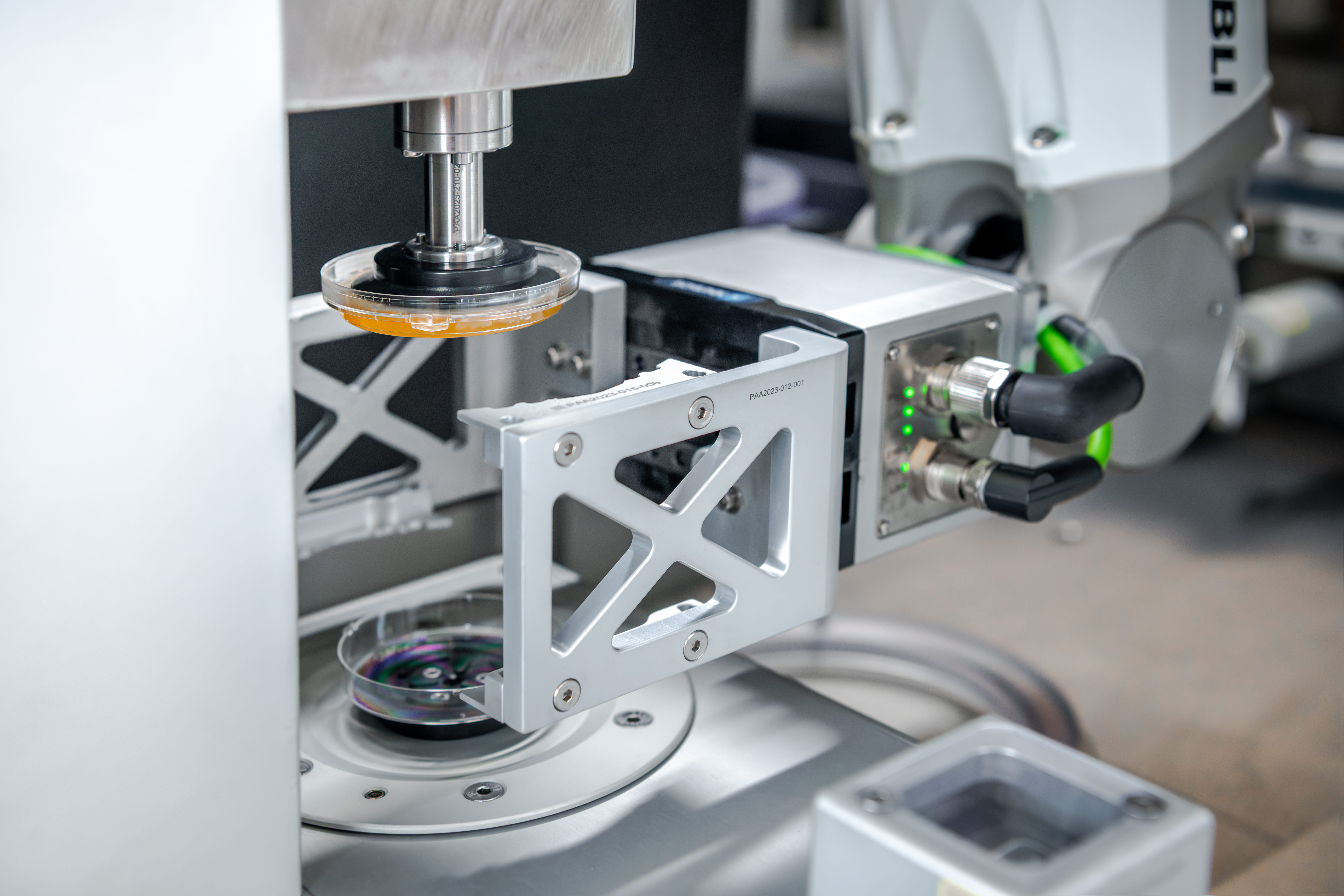
The operator places the plate into the format-specific interchangeable module, with the barcode facing the system opening. Standard support is provided for the 55 mm and 90 mm formats from manufacturers PMM and Merck, with the 150 mm format available as an optional extension. The system detects whether the correct interchangeable module has been inserted. In the semi-automated version, a cobot handles singulation from a reservoir holding up to 50 plates and opens them at an automatic de-lidding station; the fully automated version utilizes an industrial robot and a magazine capable of holding up to 400 plates.
Image acquisition and analysis
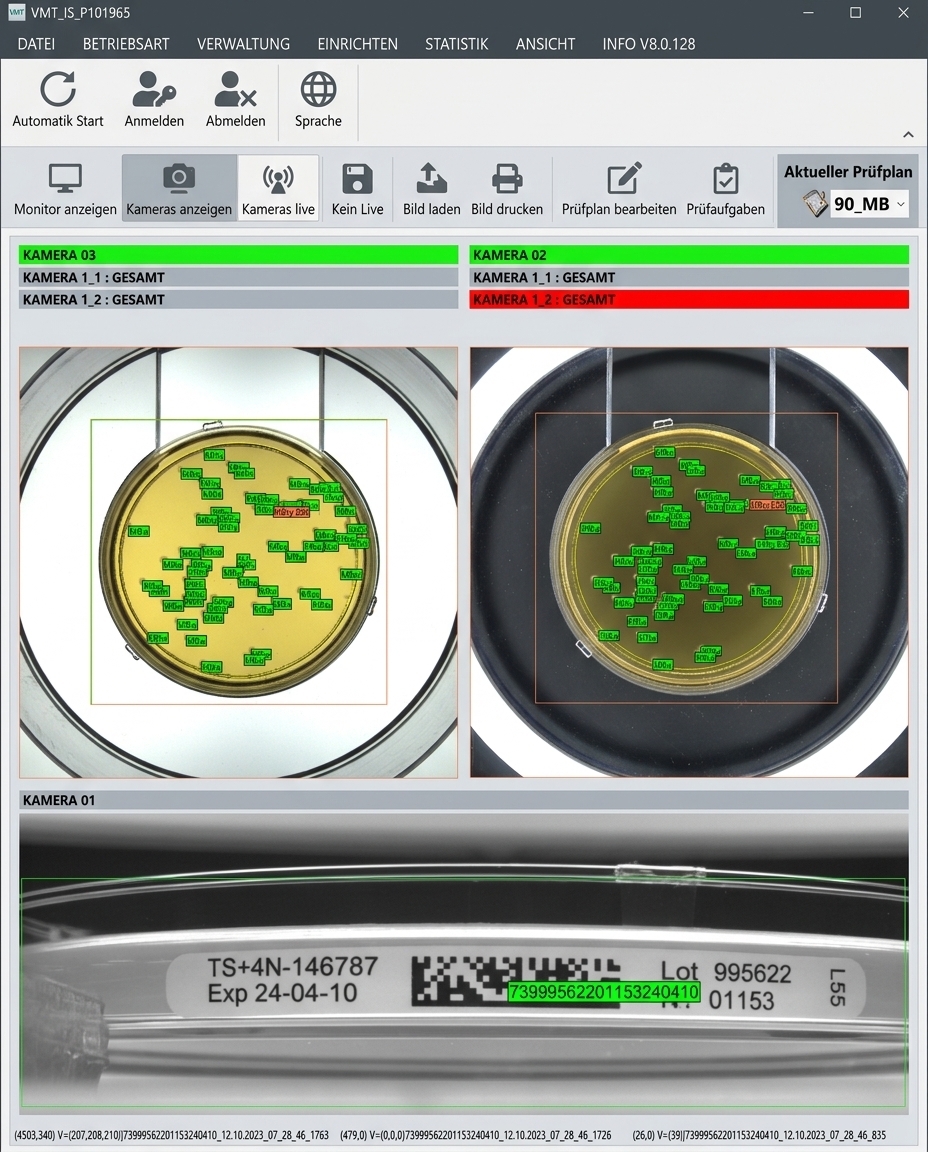
Two images are captured for each plate: one using incident light and one using transmitted light. Some features are visible only under one lighting condition while others appear only under the other; a reliable assessment is only possible by combining both. Analysis is performed using trained deep-learning models at two resolution levels: a coarse level for confluent growth, large colonies, and extensive defects, and a fine level for small colonies, foreign particles, cracks, and bubbles in the agar. The analysis covers the entire plate surface, including the edge area. The actual analysis time is approximately 7 seconds for 55 mm plates, 10 seconds for 90 mm plates, and 15 seconds for 150 mm plates. The manual inspection station is designed to handle up to 200 plates per hour. Target detection performance metrics are a false acceptance rate of 0.24% and a false rejection rate of 2.0%.
Result, sorting, and documentation
The result is indicated directly on the system: red if at least one defect is found, green for a defect-free plate, and white to signal readiness. Both semi-automatic and fully automatic versions subsequently reseal the plate and deposit it in a physically separate location—ensuring that "OK" and "not OK" plates cannot be mixed. A measurement report is generated for each plate, detailing the inspection plan, operator, date and time, sample number, and assessment, along with incident-light and transmitted-light images. The result data is transferred to the LIMS in CSV format via a transfer directory.
01
How it works

Software & Usability

Operation
Processing takes place on the VMT IS image processing platform. The inspection sequence is triggered by closing the drawer or by the handling system; no manual software operation is required during standard operation. The device's status signal is sufficient for processing defect-free plates. The operator only switches to the image view for plates classified as "not OK" (NOK), where they evaluate the incident-light and transmitted-light images, including any marked areas of interest.
User Management and Documentation
The software is classified as Category 4 (configurable software) under GAMP 5. It meets the requirements of FDA 21 CFR Part 11 and EU GMP Annex 11 through audit trails, centralized user management, and electronic records. The role-based access system utilizes tiered permission levels—managed locally or via ADS—while defined local emergency users ensure continued operation in the event of a domain connection failure. Results are available as PDF measurement reports and as CSV datasets for LIMS integration.
Configuration and parameterization
Inspection tasks are managed via inspection plans identified by unique ID numbers. Analysis sensitivity is configurable through parameter sets, with separate settings for microbiological findings and physical damage. Format changes are handled using change parts and the corresponding system configuration. A defined re-learning process exists to refine the models for customer-specific culture media and defect patterns; the qualification of this process is documented in three stages. Plans are in place to migrate the analysis function to the new VMT ONE software generation.
02
Software & Usability

Hardware

Camera and lighting
High-resolution color camera with a field of view of 160 × 160 mm; the resolution allows for the detection of individual colonies across the entire plate surface, including the edge area. Two separate lighting systems generate incident light from above and transmitted light from below, each providing homogeneous area illumination. Optionally, additional cameras capture DMC labels for plate identification.
Modular system design
The core component is the self-contained image processing module, comprising cameras, lighting, and analysis systems. Its design is identical across all three configuration levels, which differ solely in terms of handling. Manual inspection station: a compact benchtop system with a drawer, measuring 450 × 480 × 584 mm and weighing approximately 30 kg. Semi-automated system: an open benchtop setup featuring a cobot, a de-lidding station, magazines for segregated sorting, and two discharge stations. Fully automated system: an enclosed unit with an industrial robot, an expanded magazine system, and a dedicated barcode reader for autonomous operation.
System platform and peripherals
GPU-based industrial PC for deep learning analysis. Three mounting options: integrated into the system housing with filter mats for CNC areas; in a remote control cabinet for cleanroom class D; or in a cleanroom housing with a heat exchanger instead of a fan. Connection to machine control via PLC. Hygienic design housing with no dead spaces or exposed threads; inspection module protection rating IP65/67. Wipe disinfection with isopropanol permitted; interchangeable parts may also be cleaned with DI water; UV irradiation of the interior for decontamination.
03
Hardware

Our team will be in touch as soon as possible.

FAST RESPONSE TIMES
EXPERT CONSULTING & SUPPORT
SOLUTION-DRIVEN APPROACH
01
02
03
04
Submit
Thank you! Your submission has been received!
Oops! Something went wrong while submitting the form.