Medical Pouches

Every bag sealed, every solution clearly inspected.
Home
Life Science
Medical Pouches
Infusion bags are primary packaging components for solutions that enter the bloodstream directly. The film, seal seam, port, and closure together form the sterile barrier throughout the entire shelf life.
Production takes place on a continuous web: film is formed, sealed, fitted with a port and closure, filled, and marked. Defects can occur at any of these stations; they are often transparent or measure only a few tenths of a millimeter, making them virtually indistinguishable to the eye on the finished product.
Image processing inspects the bag and solution in line with the production cycle, using reproducible criteria and documented inspection results for every unit.

One Process. Every Step Covered.

The right technology at every stage.
01

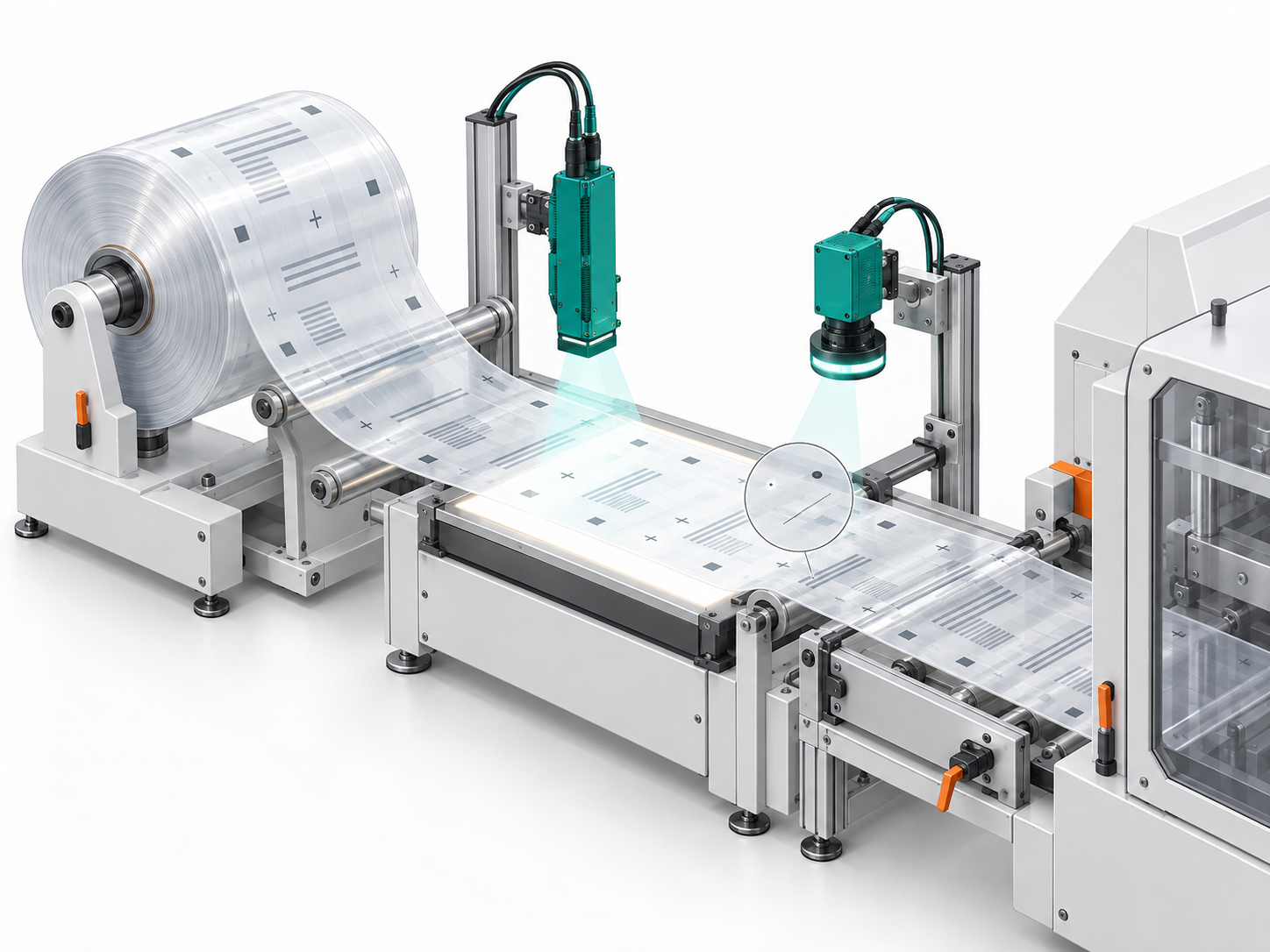
Film feed and film monitoring

  • The multilayer plastic film feeds from the roll into the forming station. The film already bears pre-printed, product-specific labeling.
  • Requirements: inspection of the moving web without interrupting the production cycle; detection of transparent and low-contrast defects using transmitted light; character-level verification of the pre-print.
  • Inspections cover holes, inclusions, particles, scratches, and streaks in the film, as well as the completeness and legibility of the pre-print. A defective film web results in defects in every pouch formed from it until the issue is detected.
  • Technology: VMT Inspection Solutions
02

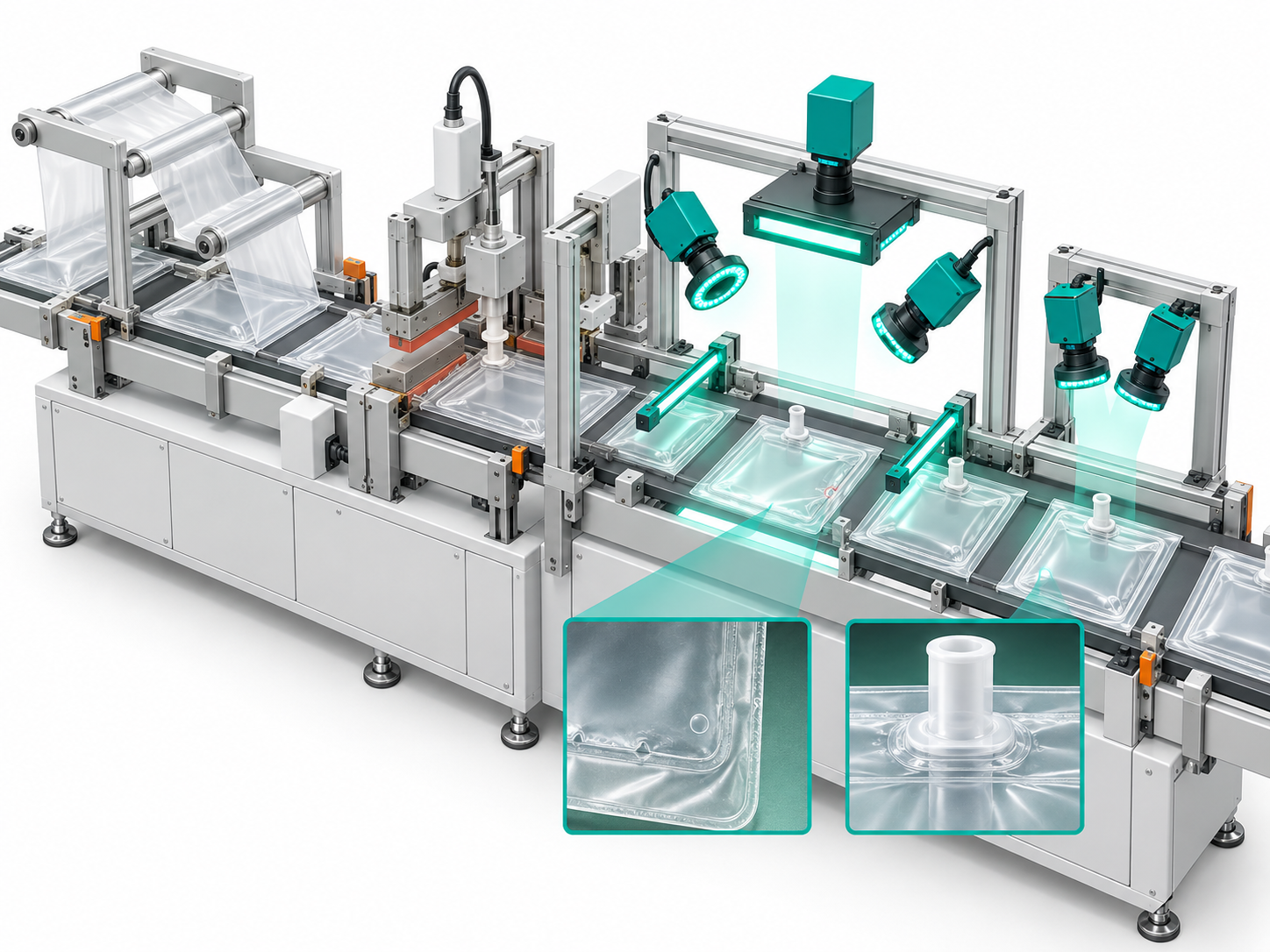
Pouch forming, sealing, and port attachment

  • The film is formed into a bag and sealed via longitudinal and transverse seams. The port is inserted into the seam zone and welded to the film.
  • Requirements: resolution capable of detecting defects within the seam zone along the entire seam length; differentiation between fully sealed and unsealed areas within the transparent laminate; measurement of seam width and port positioning in a continuous production line. The system inspects the completeness and width of the seal seams, as well as interruptions, notches, bubbles, channels, folds, overlaps, delamination, seam misalignment, and bag geometry.
  • Port inspections cover presence, complete welding to the bag, weld flash, obstruction of the port opening, misalignment, and flange geometry. Additionally, the system detects film damage and external surface contaminants. An unsealed section within the seam compromises the sterile barrier—a defect that cannot be reliably detected from the outside of a filled bag.
  • Technology: VMT Bag Inspection
03

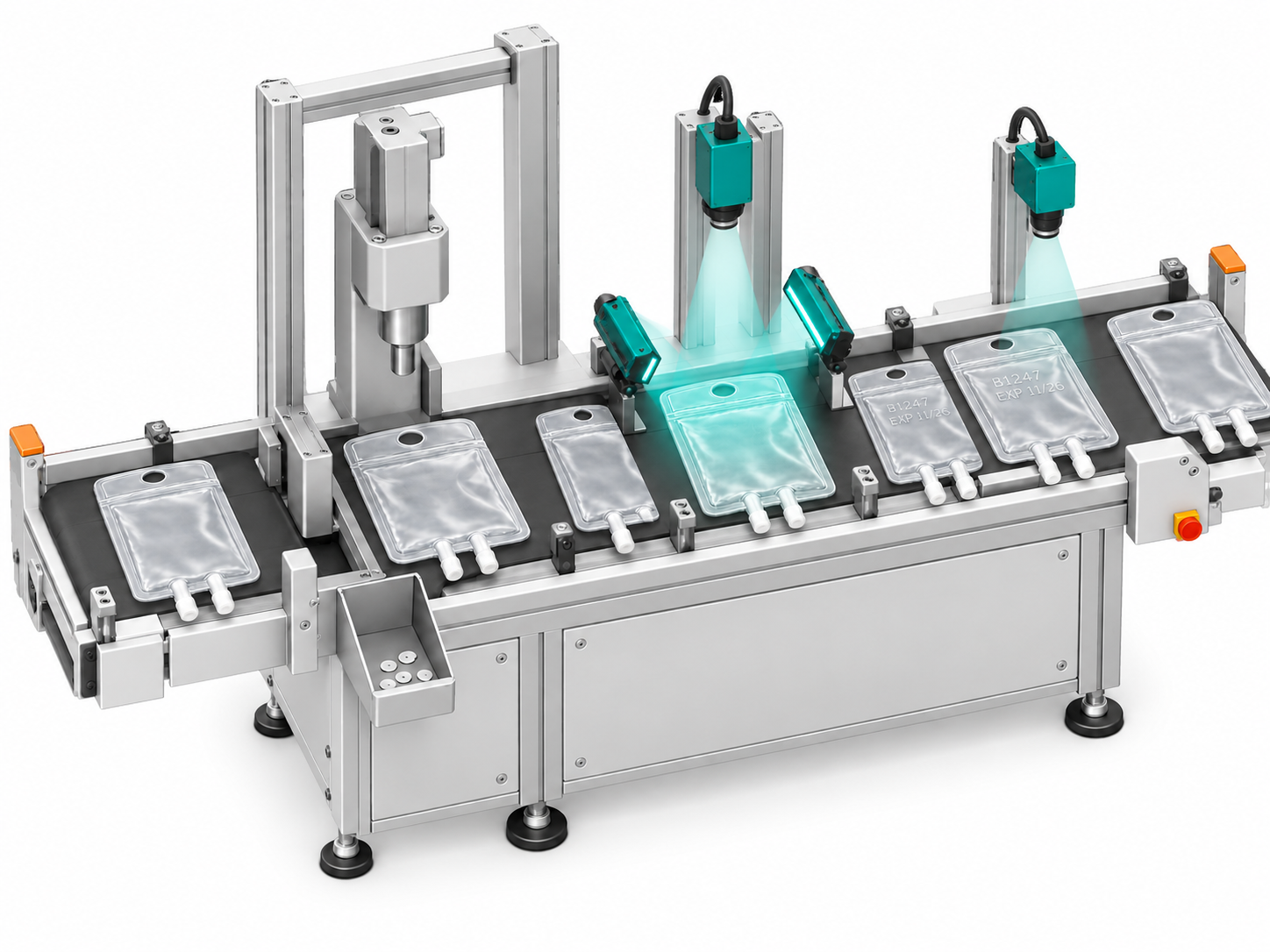
Hanging hole and batch identification

  • The suspension hole is punched into the upper seal area. The batch number and expiration date are embossed onto the bag.
  • Requirements: positional measurement of the suspension hole relative to the seal seam; verification of complete punching and the detachable tab; character recognition on an embossed, transparent surface lacking color contrast.
  • The system inspects the position and centering of the suspension hole, the completeness of the punching, the detachability of the tab, and the integrity of the suspension flap. Regarding the embossing, the presence and readability of all characters are checked and verified against batch data; additionally, any overlap between the embossing and pre-printed information is detected. An unreadable batch identifier renders the unit untraceable.
  • Technology: VMT Inspection Solutions
04

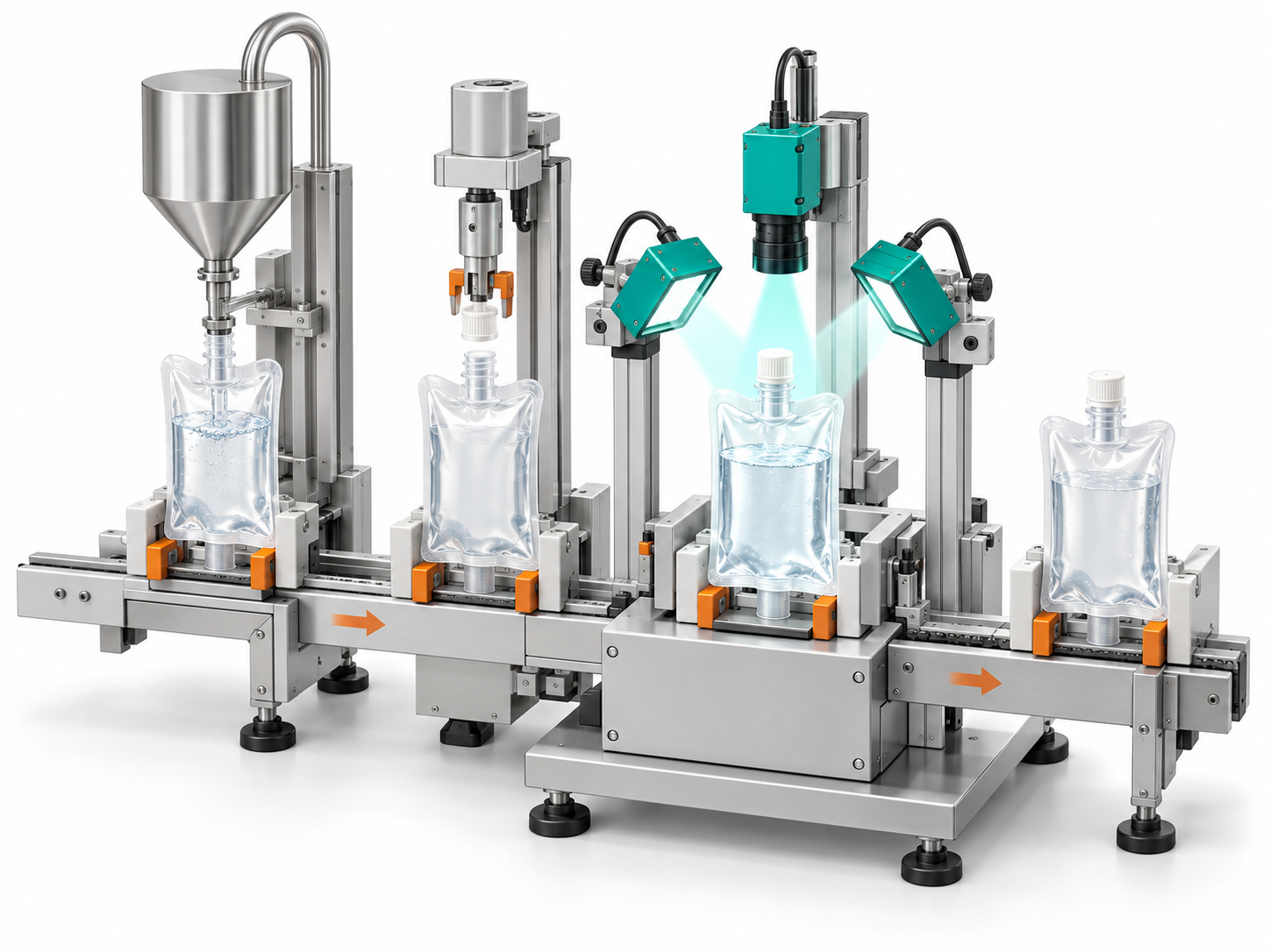
Filling and closure assembly

  • The bag is filled via the port. Subsequently, the cap is applied and secured.
  • Requirements: Verification of the presence and seating of the cap on the filled bag; detection of the cap regardless of rotational orientation or reflections; inspection synchronized with the filling line speed.
  • Checks are performed for the presence of the cap, its correct and complete seating on the port, and any damage to the cap. A missing or improperly seated cap compromises the sterile barrier immediately after filling.
  • Technology: VMT Inspection Solutions
05

Final check of the solution

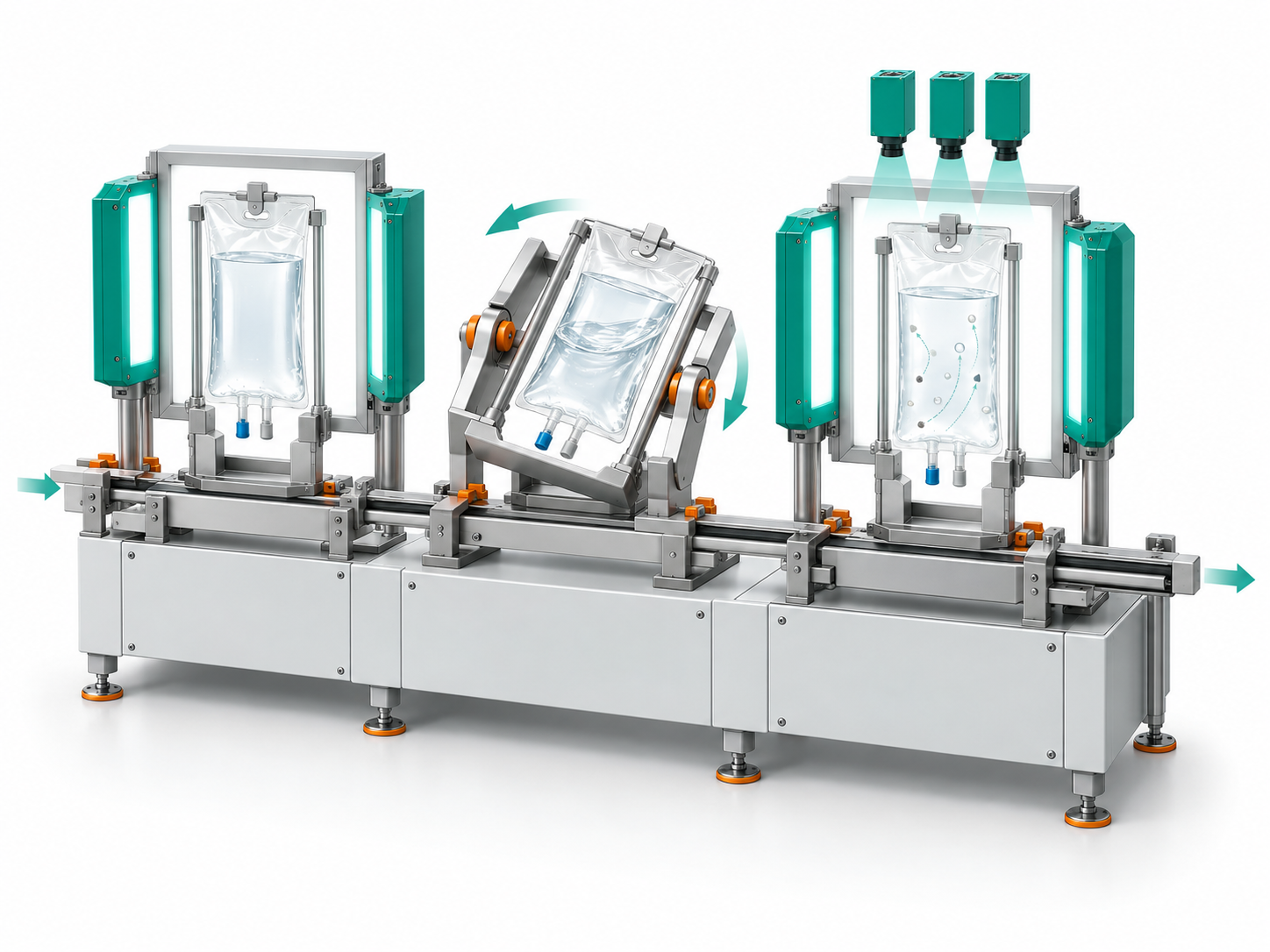
  • The filled and sealed bag reaches the final inspection stage. To check for particles, the solution inside the bag is set in motion.
  • Requirements: assessment of the stationary solution for turbidity and color deviation; inducing fluid movement and analyzing the sequence over time rather than a single image; distinguishing between particles and air bubbles based on movement behavior. With the bag stationary, the solution is evaluated for turbidity and discoloration against specifications.
  • After movement is induced, freely moving particles in the solution are detected, classified by size, and distinguished from air bubbles. Particles in the solution pose a direct risk to patients and cannot be detected after packaging.
  • Technology: VMT Bag Inspection
Back

Our team will be in touch as soon as possible.

FAST RESPONSE TIMES
EXPERT CONSULTING & SUPPORT
SOLUTION-DRIVEN APPROACH
01
02
03
04
Submit
Thank you! Your submission has been received!
Oops! Something went wrong while submitting the form.